Ask CPA Trendlines
Now, with smarter search, deeper analysis, more detailed responses (v.2.7).
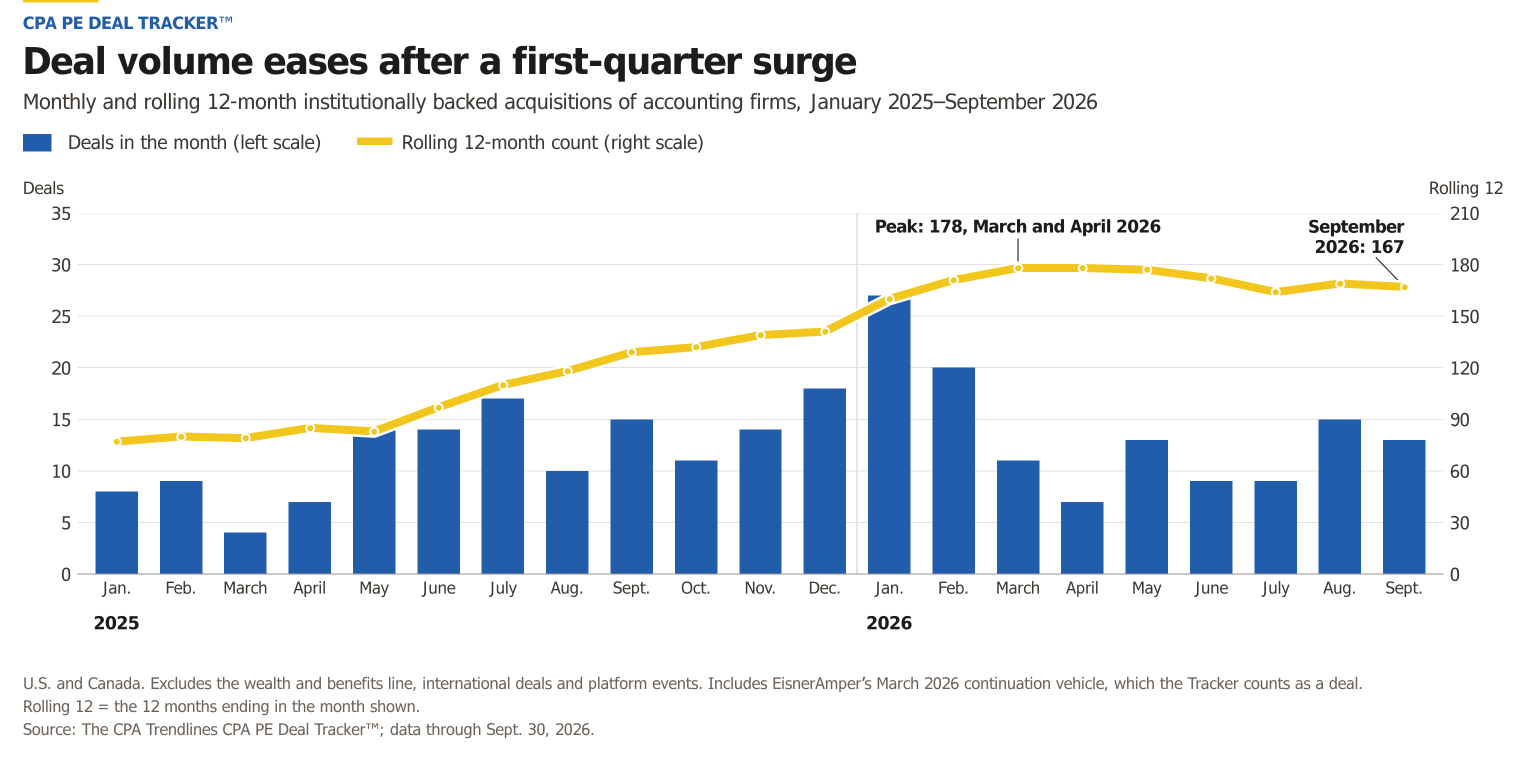
Tracker surges into 2026 with more than 200 transactions.
In January alone, dozens of private-equity-backed deals surfaced — more than a quarter of all 12 months last year. And it hasn’t slowed down yet.
By CPA Trendlines Research
Cornerstone Reports
Former Baker Tilly CEO Alan Whitman is returning to the center of accounting’s private equity vortex with a new mandate and a new sponsor, taking the helm of a newly capitalized triple-threat CPA firm, insurance agency, and transaction consultancy.
Alan Whitman: Breaking the Mold with PE Backing | Holistic Guide | MORE Cornerstone Reports | MORE Private Equity
In the new edition of the CPA Trendlines PE Deal Tracker™, Madison Dearborn Partners, the Chicago-based private equity firm, founded in 1992 and managing more than $28 billion in assets, is backing the combination of Nichols Cauley, a Georgia-based CPA firm, with Partners Risk Services and JGH Consulting in a three-entity formation designed not as a tuck-in acquisition but as an integrated advisory foundation from inception.
At Nichols, an eight-office regional leader, Whitman may be inventing more than the next generation of CPA firms. It could be a new breed. “It’s going to be a lot of fun scaling a new product,” Whitman tells CPA Trendlines’ Rory Henry in the latest episode of The Holitic Guide to Wealth Management. “It’s kind of a new category in the space.”

Exclusively for PRO Members Only, here
By CPA Trendlines Research
The accounting profession is changing faster than at any time in its modern history—and private equity is driving the shift. More than $30 billion in new capital has entered CPA firms since 2020, igniting a powerful wave of consolidation, modernization, and strategic reinvention. Firms that once relied on incremental growth and traditional partnership structures are now operating as high-performance platforms built for scale, technology adoption, and national reach.
The CPA PE Playbook is the most comprehensive analysis available today on this historic transformation.
If you want to know where the profession is heading, how PE-backed firms are competing, and what it will take to thrive in the next decade, this is the report you need.


BONUS: a telephone screening form.
By Marc Rosenberg
CPA Firm Mergers: Your Complete Guide
Even though these questions are primarily intended for larger firms to ask smaller firms, some of the questions may be appropriate for the smaller firm to ask larger firms. These are general questions; based on your review of the other firm’s data, you will certainly have specific questions to ask in addition to those below.
An important goal of these interviews is to get open, honest and brutally candid responses. At most firms, this is virtually impossible if you interview two or more partners together. Only rarely, where two or three partners appear to be “joined at the hip,” is it acceptable to do group interviews.

Our exclusive expert council offers insight.
By Martin Bissett
Passport to Partnership
The Passport to Partnership study collated a number of responses from existing partners of accounting practices in a conversational style.
Examples that really stood out on the realities of individual variances in firm culture are showcased below.
“Our partners have articulate minds, and that’s what we want to be demonstrated by any new appointees.” Meaning, can they hold their own intellectually in more senior circles?
How would they then behave when meeting with other senior executives as a contemporary of theirs?
READ MORE →

Execute it; don’t let it sit on a shelf.
By Domenick J. Esposito
8 Steps to Great
Many CPA firms do not have a living, breathing strategic plan that enables them to successfully navigate through their next two or three years.
That in and of itself is not very surprising because most CPA firms are basically small and midsized businesses with the same generational challenges faced by most small and midsized family and privately owned operating companies. READ MORE →